The AI trade took another leg down this week despite strong earnings from NVIDIA Corp. NASDAQ: NVDA, and while dogs and cats aren’t living together yet, a mild hysteria has taken over the tech sector. The Nasdaq-100 is already down about 4.5% this month, and a rotation into safer sectors appears well underway. Investors are questioning whether hyperscaler spending can continue growing at an exponential pace, and they are looking for protection from AI-driven volatility. Utilities are a popular choice in volatile markets since their rates are heavily regulated, and they frequently pay healthy dividends. Two utilities offer steady dividend income and potential rate-case catalysts that could boost earnings.
Why Utilities Perform Well in Market Downturns
Burdensome regulation is typically a reason investors will avoid a company or industry. But in the utility sector, regulation is needed because these companies have a natural monopoly over their territories. Once critical infrastructure like pipes and wiring networks is in place, it makes no economic sense for a competitor to build a duplicate network and compete for customers. Since each utility operates as a monopoly in an exclusive territory, a state regulatory commission sets prices, and the company must serve all its customers reliably if it wants to argue for higher rates.
When utility companies file for higher rates, it’s called a rate case, and they must argue that increases are needed to recoup costs and capital. State public utility commissions (PUCs) give these companies a chance to earn a reasonable return on their investments. Still, consumers and other advocates often push back during rate cases, and utilities typically settle for less than they initially ask. However, rate base growth is the utility sector's earnings engine because utilities can earn an approved return on capital expenditures (CapEx) included in their rate base, subject to the return on equity (ROE) authorized by regulators. Approved investments can support earnings growth, while timely rate adjustments help reduce the lag between spending capital and recovering it.
2 Utilities With Healthy Dividends and Upside Catalysts
Beyond a bullish rate-case catalyst, both of these companies return ample cash to shareholders through dividends. Each dividend currently yields at least 2.5%, with a payout ratio under 70%. A payout ratio below 70% can leave room for dividend growth while balancing utilities' substantial capital spending needs.
UGI Corp: Base Rate Settlement Offers 2 Years of Visible Revenue Growth
UGI Today
$35.15 -2.90 (-7.62%) As of 11/19/2026
- 52-Week Range
- $31.65
▼
$41.34 - Dividend Yield
- 4.27%
- P/E Ratio
- 11.38
- Price Target
- $45.80
UGI Corp. NYSE: UGI hasn’t raised its dividend payout since 2023, and that isn’t changing this quarter after management declared another 37.5-cent-per-share payout on Nov. 18.
UGI also announced plans on Nov. 18 to spin off its global liquefied petroleum gas business in 2027, although dividend policies for the resulting companies have not yet been finalized. But the company trades at 11.95 times forward earnings, and the Pennsylvania PUC resolved its base rate case on Oct. 1.
The state approved rate increases 35% below UGI’s ask, and the price increases will phase in over two years. However, this agreement will create a $65 million two-step increase in annual operating revenue, with UGI receiving an extra $40 million in October 2026 and another $25 million in October 2027. While the company cannot file a new base rate request until 2029, the next two years will bring more predictable revenue growth from the new settlement.
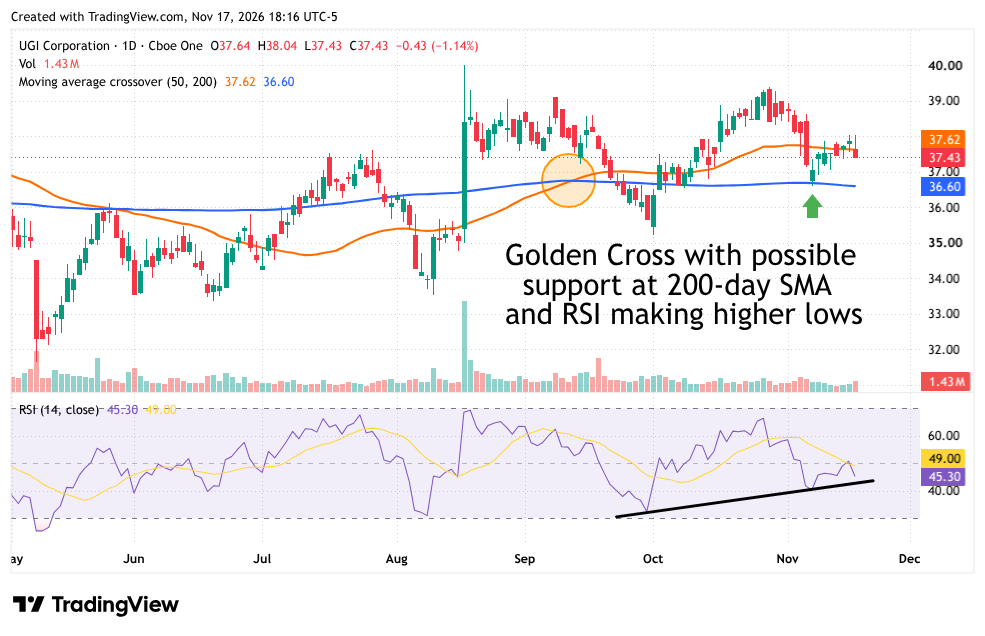
UGI shares have gone nowhere so far in 2026, up just over 1% year to date. But now that the rate case is in the rearview, technical signals are starting to show bullish potential. A golden cross in September helped push the share price above the 50-day and 200-day moving averages, and now the 200-day could serve as support that keeps the stock elevated.
The relative strength index (RSI) has also bounced off the October oversold signal, making higher lows as it approaches the bullish/bearish dividing line of 50. An RSI over 50 with support at the 50-day moving average would be a strong sign that a new uptrend has begun, so investors should monitor these levels closely over the next few weeks.
Southwest Gas Holdings: Pure-Play Utility With Potentially Lucrative Rate Case Looming
Southwest Gas Today
SWX
Southwest Gas
$89.14 -1.82 (-2.00%) As of 11/19/2026 03:59 PM Eastern
This is a fair market value price provided by Massive. Learn more. - 52-Week Range
- $78.37
▼
$94.46 - Dividend Yield
- 2.89%
- P/E Ratio
- 21.74
- Price Target
- $101.25
Last year, Southwest Gas Holdings Inc. NYSE: SWX exited its position in infrastructure firm Centuri Holdings Inc. NYSE: CTRI, leaving the company as a pure-play gas utility serving growing Western markets. Operating in parts of California, Arizona, and Nevada, Southwest Gas has a growing rate base and expects adjusted earnings per share (EPS) to compound at a rate of 12% to 14% annually through 2030.
It also has a rate-case catalyst in Arizona, the first since the Arizona Corporation Commission (ACC) approved a controversial measure called formula rates, which could allow annual rate adjustments under an approved formula instead of requiring a traditional rate case each year.
Southwest Gas originally requested a $101 million rate increase for its Arizona territory, later reducing the request to $91.3 million, and commission staff recommended $58.2 million in October. A hearing is scheduled to begin Dec. 7, and the new rates are expected to take effect in April 2027, subject to regulatory approval.
But while the gap between the request and recommendation is large, the bigger story is the potential transition to formula rates. If approved, the proposed structure would allow annual cost-of-service adjustments between full rate cases, reducing the lag between capital investment and return.
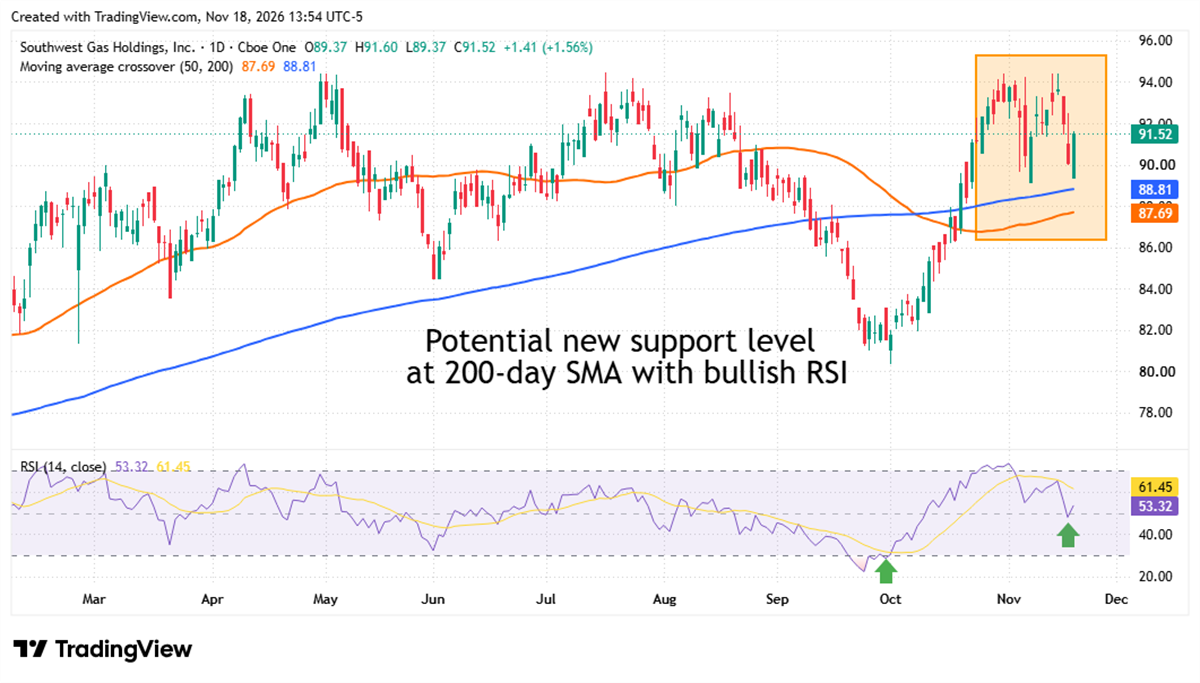
SWX shares are up approximately 13% year to date, but the path has been anything but linear. The stock enjoyed support at the 50-day moving average for most of the year before the September drawdown pushed the price below both the 50-day and 200-day moving averages.
Like UGI, the stock bounced off an RSI oversold signal in October and has been trending higher since, with new support along the 200-day moving average. The September decline, with a corresponding death cross, could prove to be a bear trap, and management reaffirmed full-year 2026 adjusted earnings guidance in the Q3 report on Nov. 4.
Before you consider UGI, you'll want to hear this.
MarketBeat keeps track of Wall Street's top-rated and best performing research analysts and the stocks they recommend to their clients on a daily basis. MarketBeat has identified the five stocks that top analysts are quietly whispering to their clients to buy now before the broader market catches on... and UGI wasn't on the list.
While UGI currently has a Moderate Buy rating among analysts, top-rated analysts believe these five stocks are better buys.
View The Five Stocks Here
Nuclear energy is entering a new growth cycle as rising power demand, expanding data centers, and renewed policy support bring the sector back into focus. After strong gains in recent years, the most impactful phase of nuclear investment may still be ahead. This report highlights seven nuclear energy stocks positioned across the value chain—combining near-term revenue with long-term upside as next-generation technologies scale. Click the link below to unlock the full list.
Get This Free Report
Continue following MarketBeat
Add MarketBeat as your preferred source on Google to see our latest stories in your feed.
