Caterpillar’s NYSE: CAT stock price is tumbling in early November, but the sell-off may be overshadowing the company’s evolving business. Investors are weighing its traditional role as a heavy machinery original equipment manufacturer (OEM), vulnerable to cyclical downturns, against its shift into a next-gen operator. Its growing power generation business supports the second view.
AI Power Demand and a Record Backlog Support Caterpillar’s Outlook
Four factors underpin Caterpillar’s longer-term outlook: AI, seasonality, margins, and visibility. AI hype has been part and parcel of CAT’s meteoric rise and subsequent implosion, with costs, bottlenecks, and interest rates plaguing many AI infrastructure stocks.
Caterpillar’s position has a distinct advantage: It is not a standard AI infrastructure play, but rather a capital equipment maker with years of lead time for its products. AI power demand is real, evidenced by the 30% Q3 surge in power generation revenue, and so is Caterpillar’s backlog, which has swelled to a record $78 billion, underpinned by reciprocating engine orders extending to 2030.
Caterpillar’s Growth Investments Pressure Margins, But Support Long-Term Revenue
Caterpillar’s third-quarter 2026 results, released Oct. 29, showed 17% revenue growth and improving operating margins. Bears pointed to the company's guidance as a reason to sell, noting that the outlook for “moderate sales growth” signaled a slowdown from the more aggressive high-teens pace posted in Q3. To them, the $1 billion volume headwind and sequential margin loss are an insurmountable hurdle, but in reality, they are easily explained by seasonality and end-market inventory realignment.
Underlying metrics, including the backlog, suggest end-market demand remains strong, leaving margin as the single biggest risk. Management was quick to point out that margin compression is due, at least in part, to self-inflicted pain, including cost absorption and aggressive reinvestment intended to unlock future value.
Caterpillar is aggressively investing in capacity and automation. It plans to triple reciprocating engine production by 2030, while automation focuses on operational quality, flow-through, and monetizing the backlog. Margins are positioned to expand significantly over the next 18 months as these projects mature. Longer-term, the aggressive investment plays into the fourth critical detail the market misprices: Caterpillar’s parts annuity.
Caterpillar’s 30-year parts annuity is the $24 billion in aftermarket parts and services realized in fiscal 2025. Each Caterpillar machine has a lifespan averaging 30 years, driving sticky aftermarket revenue for the business. Aftermarket sales are growing annually and are expected to hit $30 billion by 2030, and may exceed forecasts due to the rapidly evolving digital network. The digital network includes connected machinery and an ecosystem of applications and services, increasing annuity stickiness and resulting in 30% more sales per vehicle.
Caterpillar Has Strong Q3: Outlook Good, Capital Returns Are Safe
Caterpillar's results were in line with analyst expectations, so they did not move the share price upward, but they were strong nonetheless. Growth was seen across segments and regions, with Power and Energy up 18%, Construction Industries up 18%, and Resource Industries up 15%.
Margin news is among the catalysts driving the share price. However, putting it in perspective helps unlock the upside potential: margin compression is a sequential headwind, but margins are improving over time, giving a reason to buy this capital-returning stock. The operating margin improved by 310 basis points year over year (YOY), enabling better-than-expected earnings and a solid outlook for capital returns.
Analysts responded by lowering price targets, putting downward pressure on the stock, but the market overreacted and pushed CAT to a deep-value entry point. The lowest price target on record is $675, and recent revisions include a $685 target from D.A. Davidson, representing 8% upside as of early November.
More importantly, the consensus price target forecasts more than 40% upside, and the stock could reach that level quickly. Catalysts include upcoming results, which are likely to reflect underlying market strength, cash flow, and a solid platform for growth and margin recovery.
Caterpillar’s Pullback Puts Institutional Support to the Test
Insider selling coincided with Caterpillar’s stock price correction, but investors should not read too much into that. Insiders were selling into a massive rally, presented with more than 200% YOY gains, and taking profits according to prearranged plans.
Institutional activity is a more significant factor, with institutions owning about 70% of shares and accumulating in 2026. Their activity will likely accelerate as Caterpillar approaches its long-term 150-week exponential moving average, which could support any subsequent rebound.
Caterpillar’s chart setup is not bullish. The market shows Three Black Soldiers, a bearish continuation signal. This formation is setting CAT up to hit its 150-day EMA before Christmas and potentially move lower. The question is whether it will prompt institutional buying or if CAT will keep falling.
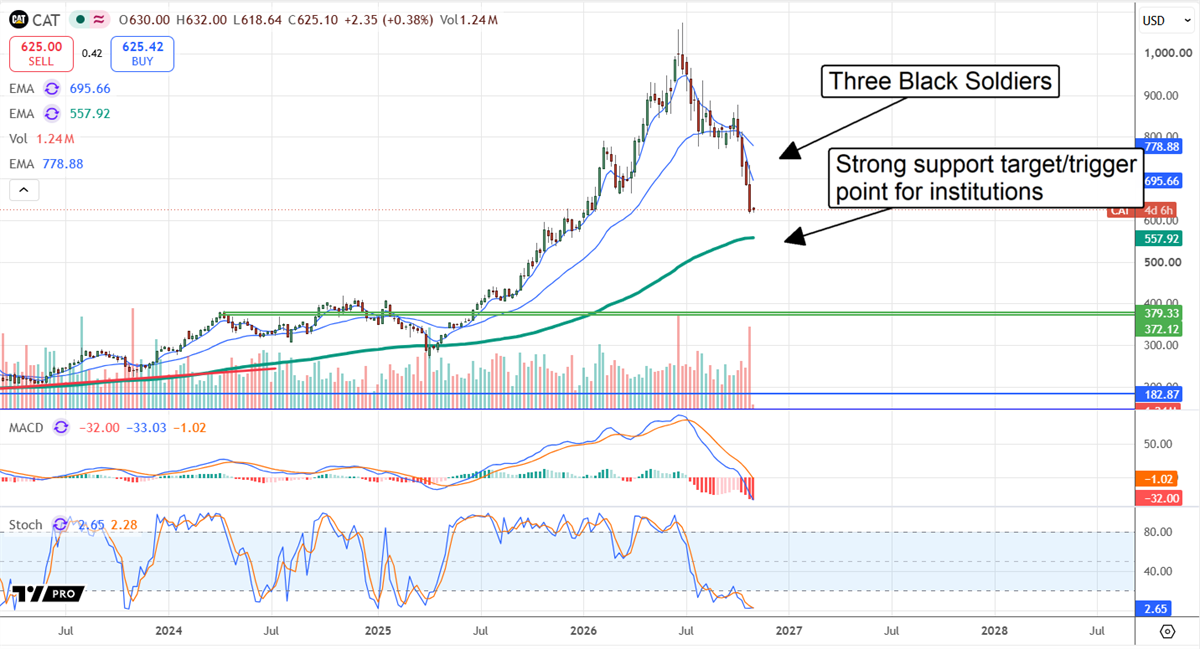
If CAT’s market doesn’t trigger a signal by crossing the EMA, it could fall all the way back to $400, giving up all the AI-influenced gains, before it bottoms and begins to rebound. Either way, the rebound will likely be strong and lingering, leading to fresh all-time highs over time. Even at $624, the stock is a deep value relative to its 2030 earnings forecast, suggesting 100% upside from early November trading levels, with only execution standing in the way.
Before you consider Caterpillar, you'll want to hear this.
MarketBeat keeps track of Wall Street's top-rated and best performing research analysts and the stocks they recommend to their clients on a daily basis. MarketBeat has identified the five stocks that top analysts are quietly whispering to their clients to buy now before the broader market catches on... and Caterpillar wasn't on the list.
While Caterpillar currently has a Moderate Buy rating among analysts, top-rated analysts believe these five stocks are better buys.
View The Five Stocks Here
Looking for higher dividend income in 2027? Discover seven high-yield dividend stocks with attractive payouts, proven dividend histories and growth potential.
Get This Free Report
Continue following MarketBeat
Add MarketBeat as your preferred source on Google to see our latest stories in your feed.
