Palantir Technologies Today
PLTR
Palantir Technologies
$157.85 +1.29 (+0.82%) As of 01:58 PM Eastern
This is a fair market value price provided by Massive. Learn more. - 52-Week Range
- $106.37
▼
$212.94 - P/E Ratio
- 110.30
- Price Target
- $216.13
Has Palantir Technologies NASDAQ: PLTR gone woke? That's what some observers and investors are taking away from an interview that co-founder and CEO Alex Karp gave to Politico. In that interview, Karp said, “I’ve been a Democrat my whole life” and called Palantir’s products “essentially progressive.” He used the word “progressive” eight times.
Some coverage framed the comments as pandering. The Register called it “a sharp left turn,” and Futurism said he was “singing an entirely different tune.” But Karp's background complicates that interpretation. He grew up in a left-leaning household in the Philadelphia area, later earned a doctorate in Germany, and has frequently said that he identifies as a progressive.
The timing invited skepticism. The interview came one week after Democrats won control of both chambers of Congress. But for investors, the bigger question is whether the political noise is obscuring what matters. That includes Palantir’s shifting revenue mix, its exposure to Washington, and a stock that is testing a key technical level.
Karp's Own Words Provide Context
The interpretation that Karp has suddenly changed his political views overlooks much of what he has said in the past. For example:
2011: Karp described Palantir as “deeply involved in supporting progressive values and causes."
2019: Bloomberg described him as a left-of-center, Hillary Clinton-supporting CEO whose company held a contract with Trump’s border police. This contradiction is not new.
2025: He said, “I’m sick and tired of left-wing people fostering right-wing populist movements because they won’t be adults about these issues.”
The 2025 comment helps explain Karp's views. His criticism appears directed at how progressive politics has played out, rather than its stated goals. That critique wasn't softened in the Politico interview. He kept attacking the Democratic Socialists of America. At the same time, he framed his support around the issue progressives say they care most about: “What are you gonna do about economic justice in this country?”
However, Karp's support for the Trump administration's immigration policies and his previous description of Palantir as “anti-woke” help explain why some observers questioned the timing of his comments.
The Headlines Mask the Headwind
The distraction surrounding Karp’s comments masks a potential headwind for Palantir. The company generates approximately half of its revenue from government customers, including about 41% from the U.S. government alone. It is also closely associated with the controversial Immigration and Customs Enforcement (ICE) agency.
That funding could face greater scrutiny when the new Congress convenes in January. Palantir also relies on U.S. defense spending. Democrats could push back against President Trump’s proposed $1.5 trillion defense budget for fiscal 2027. Critics argue the proposal funds the military at the expense of domestic programs.
However, the debate over defense spending does not eliminate the military's interest in modernization. The administration itself pitched its budget request as a modernization effort built around autonomous systems. Palantir’s Ontology, which connects data, models, and operational workflows, could play an important role in that strategy.
Commercial Growth Is a Major Tailwind
In its latest quarter, Palantir’s U.S. commercial revenue outpaced its U.S. government revenue for the first time. U.S. commercial revenue jumped 148% year over year to $984 million. U.S. government revenue rose 96% to $953 million. Total revenue grew 96% to $2.31 billion, and management raised full-year guidance for the third time this year.
That milestone should have been a catalyst. But it hit just before the midterm results coincided with a sell-off in defense and AI stocks. The numbers got lost in the political noise. Yet the growth in commercial revenue matters for the government-risk debate. As commercial revenue grows faster than government revenue, Palantir's reliance on Washington could decline over time.
PLTR Is Sending a Signal
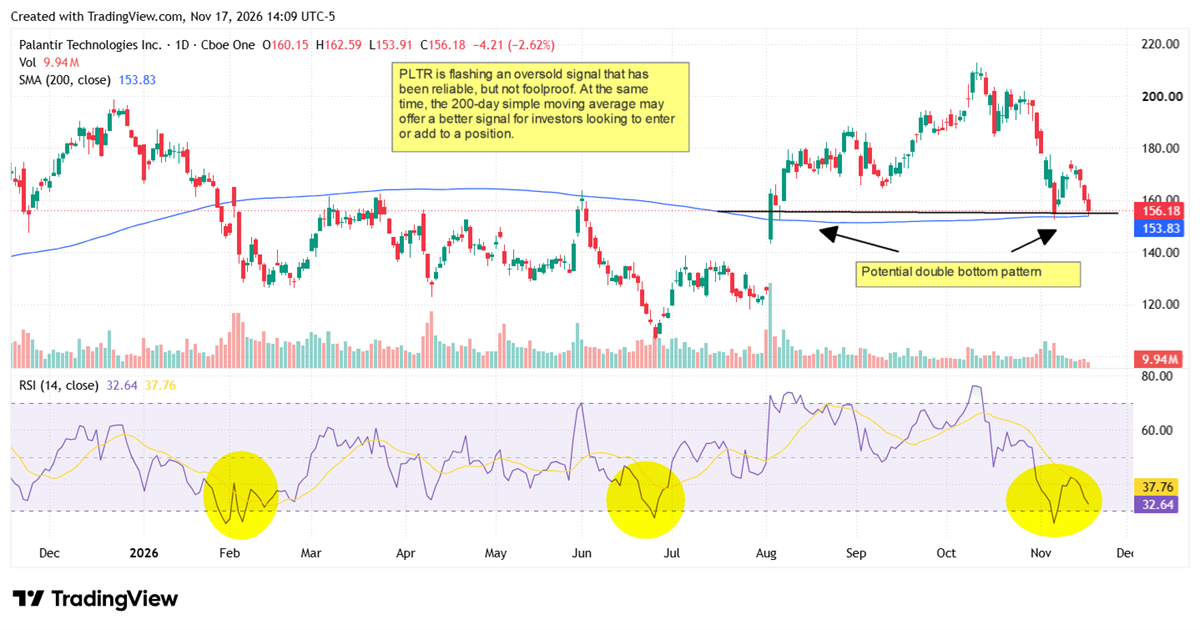
PLTR has given up most of the rally that followed its August earnings report. The stock sits more than 25% below its October high and is trading near its 200-day simple moving average. However, it’s also getting close to an oversold reading based on its relative strength index (RSI).
That has often preceded a bounce. The RSI neared 30 in late June and again in early November, and both times the stock rallied. But the signal hasn't always indicated an imminent reversal. In February, PLTR kept falling for roughly two more weeks after the RSI first approached that level.
The 200-day line may offer a more important signal. After PLTR broke below that level in February, the stock didn’t reclaim it for good until August. Shares are now retesting both the moving average and their early-November low. A hold here could form a double bottom. A decisive break could point to a longer consolidation.
Inevitably, any bounce from these levels will be met with concerns about valuation. However, several analysts continue to see upside in the stock. Phillip Securities upgraded its rating from Hold to Strong Buy on Nov. 16.
That target reflects expectations for the overall business, not commentary from the CEO. Viewed through that lens, the pullback in PLTR stock could represent a buying opportunity for investors who believe the company's performance justifies its premium valuation.
Before you consider Palantir Technologies, you'll want to hear this.
MarketBeat keeps track of Wall Street's top-rated and best performing research analysts and the stocks they recommend to their clients on a daily basis. MarketBeat has identified the five stocks that top analysts are quietly whispering to their clients to buy now before the broader market catches on... and Palantir Technologies wasn't on the list.
While Palantir Technologies currently has a Moderate Buy rating among analysts, top-rated analysts believe these five stocks are better buys.
View The Five Stocks Here
The AI boom extends far beyond the biggest tech names. Discover 10 companies supplying the memory, storage, networking, semiconductor manufacturing, and power infrastructure that make AI possible. Learn where the next wave of AI investment opportunities may emerge—and the key risks investors should watch as the global AI buildout accelerates.
Get This Free Report
Continue following MarketBeat
Add MarketBeat as your preferred source on Google to see our latest stories in your feed.
Like this article? Share it with a colleague.
Link copied to clipboard.
